%20(3)%20web%20(2).jpg)
EtonHouse Saudi Arabia
Choosing the right school for your child is one of the most important decisions you’ll make as a parent. In today’s rapidly evolving world, families are increasingly seeking more than just academics. They’re looking for educational experiences that nurture confidence, creativity, and a lifelong love of learning. That journey begins with a curriculum that truly understands how children grow, think, and thrive.
At EtonHouse Riyadh, we offer a comprehensive Reggio Emilia-inspired learning experience from preschool through primary school, thoughtfully designed to support your child at every stage of development. Rooted in international best practices and enriched with local cultural values, our curriculum inspires children to approach the world with curiosity, empathy, confidence, and a sense of purpose.
In this guide, we’ll walk you through the core of the EtonHouse educational experience, from the fundamental principles behind our curriculum to the unique ways we engage parents as partners in learning.
Why Curriculum Matters in Early Education
.jpg?width=6000&height=4000&name=DSC09823%20(1).jpg) Early childhood education lays the foundation for children's future, building their academic abilities, personality, and social skills.
Early childhood education lays the foundation for children's future, building their academic abilities, personality, and social skills.
At EtonHouse Riyadh, we understand how critical these early years are. A strong, well-rounded curriculum in the preschool and primary years can instil confidence, curiosity, and positive attitudes toward learning that last a lifetime.
Research shows that young children learn best through active engagement and inquiry – when learning is meaningful, fun, and connected to their world. In other words, the ‘how’ and ‘what’ children learn in their early years profoundly influences their growth. That’s why we believe the right curriculum in early education makes all the difference; a curriculum that supports every aspect of children’s development and sets them up for future success.
Inside the EtonHouse Approach to Learning
At EtonHouse, we observe learning as an ongoing journey. It unfolds gradually through exploration, reflection, and meaningful engagement. Our students are encouraged to inquire, think, and co-create knowledge based on their interests rather than passively receive it.
Instead of simply providing answers, we ask questions: How do things work? Why does the world behave this way? What happens if we try this? This inquiry-driven approach makes learning engaging and deeply personal. We see each child as a protagonist in their own learning journey, and our educators work alongside them as facilitators, guiding their explorations and supporting them in comprehending the world around them, making connections across different areas.
Our philosophy is inspired by the renowned Reggio Emilia approach, which means the environment plays a key role in education, and children’s interests lead the way. Learning isn’t confined to textbooks; it's demonstrated through interactions, play, and carefully designed experiences. We blend international best practices with this child-centred pedagogy, creating an atmosphere where every child’s potential can unfold.
The EtonHouse Preschool Curriculum
Our ‘Inquire ·Think · Learn (ITL)’ framework nurtures all aspects of a young child’s development. We’ve identified six key Learning Domains in our preschool curriculum, each with specific learning goals to support the whole child:
The Social Child: We foster essential social skills like taking turns, listening, expressing ideas, and negotiating with peers, all in a warm, collaborative setting.
The Child as a Communicator: Language and literacy are developed through listening, speaking, reading, and writing experiences. Children learn to express themselves effectively while building strong foundations in vocabulary and language comprehension skills.
The Thinking Child: Young learners explore concepts of math, science, and technology through hands-on discovery. This domain encourages logic, problem-solving, and creative thinking as children make sense of the world around them.
The Physical Child: We support children in developing their fine motor skills, in addition to learning about health, nutrition, and personal safety.
Creative Expression through Art: Children are exposed to various forms of art as outlets for creativity and joy. They engage in both creating art and appreciating the artistic works of their colleagues, cultivating imagination and self-expression.
The Child as Agent of Change: Even at a young age, children learn about caring for their world. We weave in lessons on sustainability and social responsibility, so children understand that their actions matter, and they’re capable of making a positive impact.
Through these six domains, our preschool curriculum targets all aspects of early development: social, language, cognitive, physical, creative, and moral. We integrate cultural understanding into all areas rather than treating it as a separate subject, helping our students develop respect for the world around them and become confident, capable global citizens right at the beginning of their journey in life.
EtonHouse Primary Curriculum
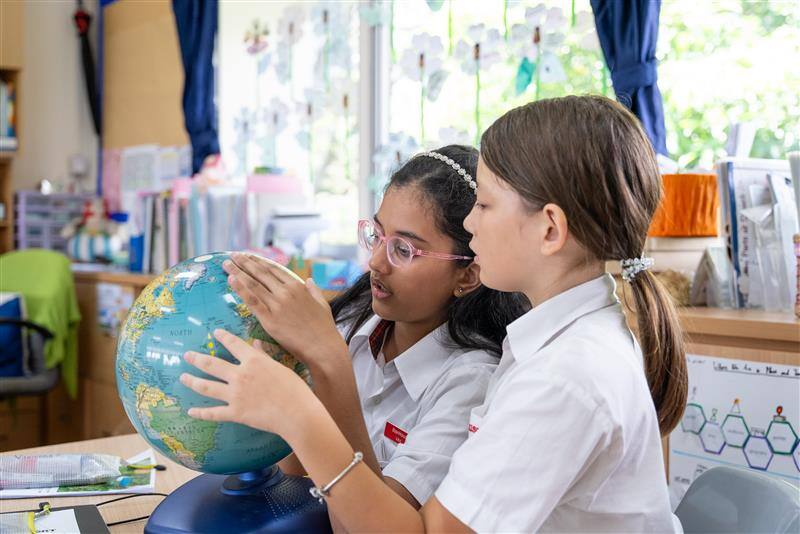 Our primary curriculum emphasises inquiry and holistic growth while introducing more structured academic frameworks.
The International Primary Curriculum (IPC)
At EtonHouse Riyadh, we follow the UK International Primary Curriculum (IPC), a comprehensive program based on the English National Curriculum, specifically developed for international schools.
IPC provides a clear learning process with globally benchmarked goals, and it’s one of the fastest-growing international curricula, adopted in over 90 countries.
Holistic Learning Goals
A distinctive feature of IPC is its balance of academic and personal aspects. The curriculum sets rigorous learning goals in traditional subjects like languages, math, science, and humanities, and it thoughtfully nurtures personal skills.
IPC’s personal goals include qualities such as adaptability, cooperation, respect, and resilience, traits that children need to thrive in our ever-changing world.
Likewise, its international goals encourage children to see themselves as global citizens, appreciating other cultures and understanding how they can be agents of change beyond their local community.
Learning is organised around broad themes that bring several subjects together. For example, instead of studying science, history, and language separately, children might explore a topic like ‘the environment’. Within that theme, the educator can plan activities that give children the opportunity to apply different skills, e.g. reading, writing, and research, in a connected way.
Singapore Maths
We also adopt Singapore’s renowned mathematics approach to build a strong numeracy foundation and develop students’ problem-solving skills. In practice, this means math classes focus on understanding concepts in depth and applying them, rather than just memorising formulas.
Children learn to use mathematical thinking to solve real-life problems, a skill that is essential beyond the classroom. We teach heuristics (problem-solving strategies) to help students approach challenges methodically, developing critical thinking along the way.
Wellbeing at the Core
Wellbeing is woven into our primary school program just as it is in our preschool. We know children learn best when they feel safe, happy, and heard. That’s why we have an active student wellbeing programme that equips learners with tools to manage their emotions, handle conflicts respectfully, and build healthy relationships.
Whether through dedicated class meetings, mindfulness activities, or our everyday positive school culture, we ensure that your child’s social-emotional growth keeps pace with their academic progress.
What Makes the EtonHouse Curriculum Different in Riyadh?
.jpg?width=1280&height=720&name=Side%20Facade%202_saudi%20IS%20with%20logo%20v2%201%20(1).jpg) EtonHouse’s Riyadh campus is designed with expansive indoor and outdoor learning spaces, reflecting a Reggio Emilia-inspired environment enriched by Saudi culture.
EtonHouse’s Riyadh campus is designed with expansive indoor and outdoor learning spaces, reflecting a Reggio Emilia-inspired environment enriched by Saudi culture.
Your child benefits from a world-class education that also feels relevant and familiar. For example, our learning themes and school events celebrate the rich heritage of Saudi Arabia, allowing children to develop a strong sense of identity and pride in their culture while embracing a global perspective.
EtonHouse Riyadh also follows a bilingual and multicultural approach to education. Our curriculum supports English and Arabic language development, with Mandarin introduced in the later stages to enrich multilingual development.
How EtonHouse Supports Parents in the Learning Journey
At EtonHouse, we view our relationship with families as a partnership. From preschool through primary school, we strive to support you—not just your child—in meaningful, tangible ways.
Transparent Communication and Tours
We invite parents to explore our campuses firsthand. Families in Riyadh can book a school tour and register for the academic year via our official site. That way, you can experience our joyful learning environments yourself.
Community and Collaboration
Our learning communities are collaborative spaces where educators, children, and parents work together. We encourage parent involvement through regular updates, workshops, and open dialogue.
Holistic and Personalised Support
Through small class sizes and a focus on wellbeing, we tailor the learning journey to each child’s strengths, interests, and needs. We keep you informed of both academic progress and emotional development.
Preparing for Tomorrow
We guide you through transitions, from early years to primary school and beyond, and help you understand the choices ahead.
Experience our progressive learning approach in action. Book a tour today to meet our passionate educators and step into our inspiring classrooms.
